Dynamic (moving-coil), condenser, ribbon
These refer to the small part inside that responds to sound, called the microphone element.
 The Sound Question
LESSON 24 · RECORDING & PRODUCTION · PART 2
A microphone turns sound moving through the air into an electrical signal you can record or amplify. Some are built for stage vocals, others for quiet instruments, voices on camera or sound from a distance. Different designs can do the same job, and the best match depends on what you're trying to capture.
01 / THE NAMES
Think of a microphone as a tool with several separate features. The words printed on a box may describe completely different things, so they shouldn't all be treated as competing “types.”
These refer to the small part inside that responds to sound, called the microphone element.
These describe which directions are picked up more strongly. They are called pickup patterns.
These describe a microphone's shape, position or special design for a particular task.
These explain how the signal reaches a computer, recorder, mixer or sound system.
A microphone can be a condenser, shotgun, XLR model at the same time. Another might be a dynamic (moving-coil), handheld, wireless microphone. Neither label gives you a complete answer about its sound quality.
We already explain microphone pickup directions and their patterns in the recording-sources lesson. Here we're concentrating on the actual designs, the jobs they suit and how those jobs overlap.
02 / INSIDE THE MICROPHONE
Every conventional microphone starts with something that moves when sound reaches it. The main difference is how that tiny movement becomes an electrical signal.
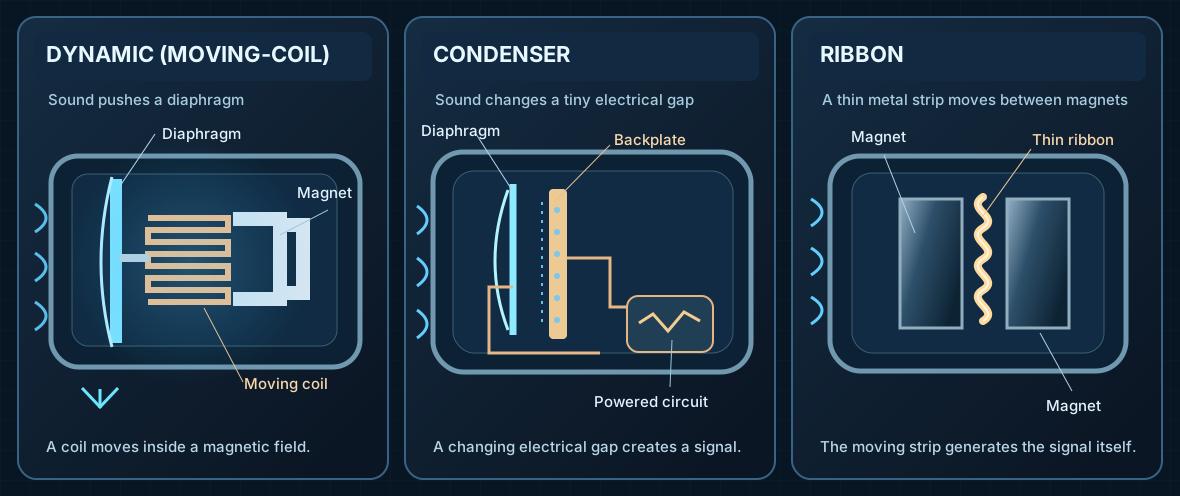
This is the design people usually mean by a dynamic microphone. A diaphragm is a thin surface that moves when air vibrates. In this microphone it moves a tiny coil of wire in a magnetic field. That creates a small electrical signal.
Why choose it? Many designs are sturdy and make practical close-up microphones for singers, speakers, snare drums or guitar amplifiers. Their electrical output is often modest, so the equipment you connect them to may need to increase it substantially.
What not to assume: A dynamic microphone does not automatically reject more room noise or capture less detail than a condenser. Microphone position, pickup direction and the exact model matter.
The diaphragm sits extremely close to a fixed surface called the backplate. Sound changes the gap between them, and powered electronics turn that electrical change into a usable signal.
Why choose it? Condensers are common for studio vocals, acoustic instruments, piano, choirs and microphones placed above a drum kit. Some offer low self-noise, which can help when recording quiet sounds.
What not to assume: Condenser doesn't mean universally more accurate, more revealing or unusable in a bedroom. Some handle exceptionally loud instruments; some do not. Read the individual model's specifications.
Instead of moving a separate coil, a thin strip of conductive metal moves in a magnetic field and generates a signal directly. Technically, this makes a ribbon a kind of electromagnetic dynamic microphone, although recording engineers usually discuss it as a separate family.
Why choose it? Some ribbons offer a smoother-sounding upper range or a useful front-and-back pickup arrangement on brass, strings, electric guitar cabinets or room recordings.
What not to assume: “Ribbon” doesn't guarantee warmth. Some models need plenty of microphone-preamp gain; some are active and require power. Wind blasts and rough handling can harm certain ribbon elements.
You may hear “small-diaphragm condenser” (often a slim pencil-shaped microphone) and “large-diaphragm condenser” (often a larger studio microphone). These describe the moving element's size, not two separate methods of generating a signal. Different capsule sizes and designs can change directionality, handling noise and the way high notes arriving from the side are recorded. Large doesn't automatically mean fuller bass or better sound.
Some condensers use an electret, which keeps a permanent electrical charge within the capsule. Others use an external polarization supply. Both may still need electrical power for their output electronics.
03 / OTHER DESIGNS
These names mainly tell you how a microphone is built or positioned. They're not alternatives to “dynamic” and “condenser” in the same sense.
Usually a directional microphone with a slotted tube in front of its capsule. Sound arriving from the sides travels through different paths in that tube and can partly cancel, making some directions less prominent. Often used above actors on a boom pole, outdoors or for camera dialogue.
Limit: It isn't a zoom lens for sound. It still needs sensible distance and careful aim. Reflections in small indoor rooms can make off-axis sound less natural; a shorter directional microphone may work better.
A tiny microphone clipped to clothing, useful when someone moves, stands at a lectern or appears on camera. Many use miniature condenser elements. Clothing rustle and where it's attached can be more important than its tiny size.
Sits near the mouth and moves with the wearer's head. Useful for performers, presenters, gaming and sports commentary because mouth distance stays fairly consistent. It can be wired or wireless, dynamic or condenser.
Built to hold or mount on a stand. Typical on stage, at events and in interviews. Some are dynamic (moving-coil), some condenser. Handling noise, breath blasts and durability matter.
Placed on or against a table, floor or other large surface. The position can reduce certain reflections between that surface and the microphone. Used for conferences, theatre and particular musical recordings.
Instead of mainly hearing air, it senses vibration transmitted through an instrument or surface. Some acoustic-instrument pickups work this way. It can reduce airborne sound pickup, but may not reproduce the same sound as a microphone placed in front of the instrument.
Built and often calibrated so measurements can be interpreted with known response information. Helpful for checking loudspeakers and rooms. It's selected for trustworthy measurement, not because it has a magic listening sound.
These use more than one microphone element or channel to capture directional cues. Stereo records two channels; binaural techniques aim to recreate ear-like cues; more elaborate arrays capture directions for later processing. They're arrangements, not a single element type.
Very small microphones made with manufacturing techniques similar to those used for chips. Found in phones, laptops and earbuds. A miniature package tells you little by itself about the finished recording's quality.
A useful overlap: A wireless lavalier may contain a miniature condenser, and a shotgun on a boom may also be a condenser. If someone asks whether a shotgun is “better than a condenser,” those labels are describing different things.
04 / CONNECTIONS & POWER
The microphone makes a signal. Your other equipment needs a way to receive and record or amplify it. The connection changes how this happens; it doesn't automatically make the capsule better.
Usually contains the small amplifying circuit and the electronics that turn the signal into digital audio for a computer. A straightforward way to record a voice or stream without a separate audio interface (the box that connects audio equipment to a computer).
Check: Monitoring options, how many microphones you need at once, your computer/phone compatibility, and whether you need to record separate tracks.
Typically sends an analogue microphone signal through an XLR cable to a mixer, audio interface or recorder. That device normally provides a microphone preamp, a circuit that boosts the mic's small signal before recording.
Check: Suitable microphone inputs, available gain, power requirements and number of separate inputs. XLR doesn't automatically sound better than USB.
A small transmitter sends the audio to a receiver instead of using one long cable. The microphone itself still has a capsule and may be condenser or dynamic (moving-coil). Wireless adds batteries, radio reliability, pairing and sometimes delay to consider.
Some microphone inputs can send power through an XLR cable, commonly 48 volts. It's called phantom power. Many condensers and active ribbons need it; other models use batteries, separate supplies or USB power.
Passive ribbon microphones generally don't need phantom power. Never rely on blanket claims that phantom is always harmless or always destructive: check the microphone instructions, cable wiring and safe connection procedure.
For the full explanation of what happens as sound enters a computer, see the existing recording-path diagram. For recording level and avoiding clipped peaks, see setting microphone recording gain.
05 / WHERE THEY OVERLAP
These examples are starting points, not hard rules. The microphone's distance, the room, the person or instrument, and the connections you own can overturn a typical recommendation.
Try: A USB or XLR dynamic (moving-coil) microphone on a boom arm, or a suitable condenser close to your mouth. A headset can help if you move around.
Why: Keeping your mouth at a predictable distance often matters more than buying a microphone advertised as “broadcast quality.” Speakers playing out loud may leak into the mic; headphones help.
Try: A studio condenser with a pop filter, or a dynamic microphone if it suits your voice and room. Both can make good recordings.
Why: Aim, distance, unwanted room reflections and consistent performance change what is captured. The earlier microphone-placement example shows why moving the same microphone matters.
Try: A small-diaphragm condenser, a suitable large-diaphragm condenser, or another model whose sound and pickup behaviour fit the instrument.
Why: You may want natural detail and may care about the microphone's own noise when recording quiet sounds. Placement usually changes the tone greatly.
Try: A sturdy dynamic (moving-coil) mic close to the source. Condensers and some ribbons can also work when their limits and placement are respected.
Why: Durability, handling, allowable sound level and the source's actual tone matter. “Loud source = dynamic only” is too simplistic.
Try: One well-positioned mic for a simple kit sound, a stereo pair for a different overall picture, or several suitable microphones when you want more control over individual drums.
Why: More mics can make separate adjustments possible but also need more recording inputs and more care with how their signals combine. This is different from making drum sounds entirely inside software.
Try: A lavalier on the person, a boom-mounted microphone held out of the frame, or a handheld microphone depending on how the subject moves.
Why: Distance and unwanted sound matter. A shotgun can be excellent in the right place but doesn't pull a whisper from far away or erase reverberation in a hard-walled room.
06 / BEFORE YOU BUY
You don't need to understand every printed number. Look for the information that answers a question about your recording situation.
Some directional microphones boost lower frequencies when positioned very close to a sound source. This is called the proximity effect; it varies with microphone design. It's one reason changing mouth distance can change the bass in a voice. An omnidirectional design using a pressure capsule ordinarily avoids that particular effect.
To compare microphones fairly, use the same performance and controlled placement where possible. Match the recorded playback loudness; otherwise the louder sample may seem more impressive even if the microphone itself is not better. For a fuller explanation of recording levels, use the gain lesson.
07 / PUT IT TO USE
Are you speaking at a desk, recording music, putting a mic above a drum kit, filming someone who moves, or singing live? The job decides which properties matter first.
Then: Think about placement, surrounding sound, whether you must move, and the connections your equipment supports.
A USB mic may be plenty for a solo creator; XLR equipment may suit someone adding multiple microphones. A dynamic, condenser or ribbon can overlap with another category in real recordings.
Then: Compare actual models and your setup, not promises attached to a microphone family.
SOURCES / FURTHER READING
These references explain microphone design and technique; they aren't evidence that one brand or model is universally better. Our drawings are simplified teaching illustrations, not factory cutaways or tested performance.