Studio, home or audience?
Is it meant to help judge a recording, enjoy music at home or carry sound to a group of people?
 The Sound Question
LESSON 22 · SPEAKERS
A speaker on a recording desk, one beside a living-room couch and another above a concert audience all do the same basic thing: turn electrical signals into sound. But they're expected to work at different distances, levels and listening positions. That changes which features matter most.
01 / THE WORDS
The names are confusing because they describe different things. Think of four separate questions about any speaker.
Is it meant to help judge a recording, enjoy music at home or carry sound to a group of people?
How far away is the listener, and how many seats must hear the result clearly?
Where does it stand, hang or fit? The box's shape can affect placement, but doesn't by itself tell you sound quality.
Does it need an external amplifier, or are some or all of those electronics built into the system?
For example, a compact powered speaker can be used for nearfield studio monitoring and also for hi-fi listening on a desk. Meanwhile, a large PA system and a tiny home speaker are both loudspeakers. None of these terms alone is a ranking of fidelity.
We've already explained two-way and three-way driver arrangements. This lesson concentrates on the jobs speakers do, not on counting their drivers again.
02 / DIFFERENT JOBS
Compare the listening areas below. The blue shapes represent the intended audience area, not measured sound beams or a promise of coverage by any particular product.
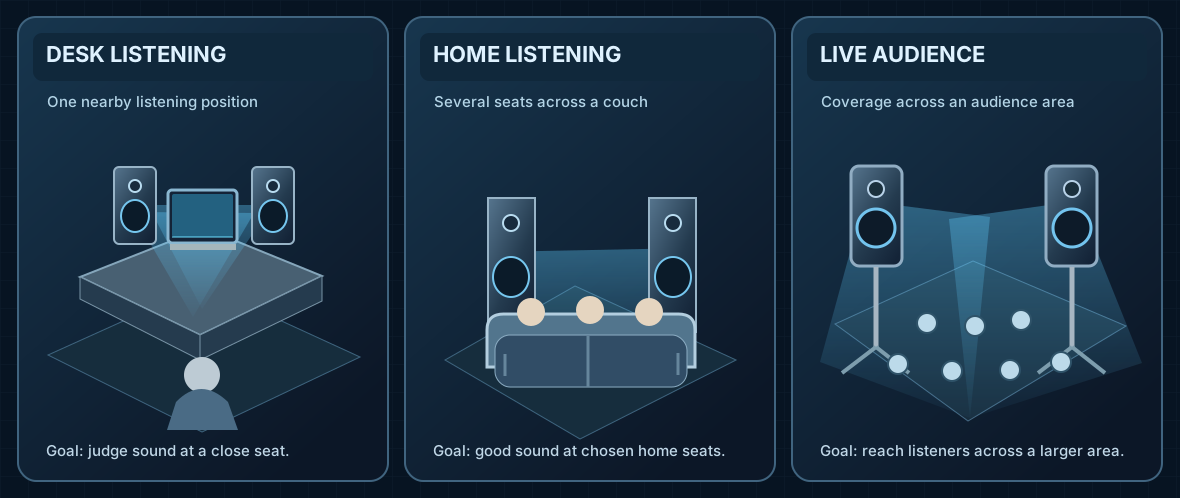
A studio monitor is a loudspeaker used to listen critically while editing, recording or mixing. A common goal is a predictable tonal balance, so the person working on the recording isn't misled by large changes added by the speaker.
Many desktop monitors have an amplifier inside and controls for their position near a wall or desk. But the word “monitor” does not prove that a speaker is neutral, accurate or suitable for every room.
Overlap: A capable studio monitor can be excellent for simply enjoying music. A suitably neutral home speaker can also be a useful mixing reference.
Hi-fi is shorthand for “high fidelity,” meaning sound reproduction intended to stay faithful to the original. In practice, home speakers vary widely: compact stand-mounts, larger floorstanders, powered speakers and home-theater systems.
Some aim for a neutral balance; others are designed with a particular presentation or practical appearance in mind. The hi-fi label alone doesn't tell you the accuracy of the finished product.
Overlap: A high-quality home stereo can be a very useful listening reference. Conversely, professional monitors can work beautifully in a living room.
PA commonly means a public-address or sound-reinforcement system. It may carry a presenter, a singer, a band or recorded music to many listeners across a space.
Compared with one home seat, the design may place greater emphasis on clean maximum volume, sound reaching the intended area, reliability, mounting, transport and control of feedback (unwanted squealing from a microphone feeding back into a speaker).
Overlap: Well-designed PA speakers can reproduce high-quality music. They aren't automatically crude or inaccurate because they're built for live sound.
03 / HOW FAR AWAY?
Nearfield describes listening from fairly close, often at a desk or small recording setup. It is a listening arrangement, not a special speaker driver, connector or requirement for a built-in amplifier.
You sit close enough that much of what reaches your ears comes directly from the speakers rather than first bouncing around the room. Often useful for working on music at a desk.
But: Reflections from the desk, walls and floor still affect what you hear, especially bass. Nearfield doesn't magically remove the room.
You listen farther away, often in a larger studio or control room. The loudspeaker needs suitable output, direction and driver integration at the actual listening position.
But: There's no single universal distance where nearfield suddenly becomes midfield.
You may listen across a larger control room to bigger or more capable monitoring systems. The setup and room become especially important.
But: A larger speaker isn't automatically a better choice if it's sitting an arm's length from your head.
Why closeness matters: Sound travels directly from the speaker to your ears, but some also bounces off walls and furniture. Moving closer can increase the direct sound relative to those reflections. It doesn't eliminate reflections or guarantee correct tonal balance. See how off-axis sound and room reflections interact for the fuller explanation.
At a desk, the speaker's height, spacing, nearby surfaces and even how a computer screen sits between them can affect the sound. The manufacturer's recommended listening-distance range is a better guide than treating a speaker as “nearfield” forever.
04 / SHAPES AND SPECIAL USES
Some speakers are built for special positions or tasks. Again, these names describe different design decisions, not competing grades of quality.
A relatively compact cabinet, often used on stands, furniture or a desk. The name doesn't mean it should literally be crowded onto a shelf. Depending on design, it may need more space or a subwoofer for deep bass.
A taller cabinet designed to stand on the floor. It may have space for additional bass drivers or a larger enclosure. Size alone does not guarantee deeper bass, accuracy or greater clean volume.
A speaker often angled up from the stage floor toward musicians. Its job is to help performers hear themselves or the band, not to provide a studio-mixing reference. In-ear monitors can serve a similar performer-monitoring role without floor wedges.
Usually a conventional PA speaker whose sound is intended to arrive from a comparatively compact source area. Practical for many events and installations. Coverage and clean output matter more than whether its case looks like home hi-fi.
Multiple sound-producing elements arranged along a line. Properly designed systems can shape where sound travels, especially across a venue. Their behaviour depends on array size, frequency, spacing, aiming and setup. A line array isn't automatically better or exempt from sound weakening with distance.
Designed to fit buildings or withstand an intended environment. Sound coverage, weather rating, service access and mounting can matter as much as stereo imaging. A speaker safe indoors is not automatically safe outdoors.
Combines playback, amplification and often wireless connection in one package. Battery runtime, practical loudness, portability and protection systems are central. A high advertised peak-watt figure isn't enough to predict actual output.
A compact system intended to improve sound near a television, sometimes using several drivers, signal processing and optional surround or bass speakers. Practical placement and TV connection features may matter more than traditional stereo separation.
A speaker focused on low bass, used with many home, studio and PA systems. It doesn't replace the main speakers, which still need to reproduce voices and the rest of the music. More detail is in the existing speaker/subwoofer lesson.
05 / POWER AND SIGNALS
Before choosing a speaker, establish how the electrical music signal is turned into enough power to move its drivers. A power amplifier boosts a signal so it can drive the speaker.
The speaker contains no built-in power amplifier for its normal input. It needs an amplifier or receiver that's electrically suitable, plus correct speaker cable and a music source.
Common: Home hi-fi separates, some installed sound systems and some PA cabinets.
The loudspeaker or pair includes its own amplification. You still need a compatible audio source, power for the amplifier and possibly volume control or a mixer. Some powered pairs have one amplified speaker connected to a second passive cabinet.
Common: Desktop speakers, studio monitors, portable PA and party systems.
In a common fully active design, the incoming signal is divided into bass and treble before separate amplifier channels drive the matching speaker parts. Powered and fully active aren't always identical descriptions.
Common: Many professional monitors and modern processed loudspeaker systems. Exact implementations vary.
What should you check? A powered monitor may require a line-level output from an audio interface, mixer or another source with volume control. A passive speaker requires a suitable power amplifier; we already explain matching a speaker's electrical load and leaving room for loud musical peaks.
Manufacturers don't always use “powered” and “active” in exactly the same way. The practical test is to look at the actual signal path: Does one amplifier drive a passive crossover inside the cabinet, or does an electronic crossover divide the signal before separate amplifiers? DSP (digital signal processing) can adjust or protect sound, but its presence alone doesn't tell you what the power-amplifier arrangement is. A passive system can also include digital processing elsewhere in the chain.
These construction details matter, but they're not a shortcut to knowing how accurate a complete system sounds.
06 / IN REAL LIFE
Notice that none of these scenarios has one mandatory speaker label. The best choice depends on the actual room, desired listening area, connected equipment, volume and limitations.
Explore: Passive bookshelf or floorstanding hi-fi speakers with a compatible amplifier; powered stereo speakers are another complete route. Good studio monitors can also work.
Check: Listening distance, where people sit, usable bass, volume control, connections, placement and the equipment you already own. The existing System Builder can help with supported home-listening paths.
Explore: Compact monitors designed for your listening distance, or suitable neutral hi-fi speakers if the complete signal path works.
Check: Space, symmetrical placement, the sound reflecting from the desk, volume control, nearby hiss and whether you have the right computer or audio-interface outputs.
Explore: A soundbar, powered stereo pair, or compatible amplifier/receiver and speakers.
Check: Connection to the actual television (for example, supported HDMI audio or optical output), dialogue intelligibility, remote-volume convenience and whether a rearrangement of the existing speakers helps first.
Explore: A suitable portable party speaker, a powered PA pair or a home system used within its real limits. Outdoor use brings safety and weather considerations.
Check: Power access, where listeners will stand, realistic clean loudness, transport and weather protection. A single wattage claim is not enough.
Explore: An audience-facing PA and separate stage monitoring where performers need to hear themselves.
Check: Who needs a microphone, how many instruments are amplified, mixer outputs, placement, feedback, safe mounting, hearing levels and available power. A desk monitor is not the same application as a stage wedge.
Explore: Suitable point-source systems, properly designed arrays or installed speakers depending on the room and where people gather.
Check: Evenness across the intended audience, sightlines, rigging safety, actual clean output and the need for professional system planning. A line array is not a magic answer for every venue.
07 / SELECTING A TYPE
Rather than using “studio,” “hi-fi” or “PA” as a quality score, match a speaker to the intended listening position and how you'll connect it.
08 / WHERE CATEGORIES MEET
If their inputs, output, placement and listening area suit your living room, studio monitors can be very satisfying for music listening. They're not restricted to mixing work.
If you understand their response and have a sensible listening setup, neutral home speakers can be a useful reference. A “hi-fi” badge doesn't automatically make them misleading.
PA can reproduce music to high standards. Its extra attention to output and audience coverage may be useful at an event, but less practical beside your desk.
You can listen to passive or powered speakers close-up. “Nearfield” refers to where you sit, and it doesn't guarantee small dimensions, a flat response or a specific amplifier design.
The final question: “Which one sounds best?” has no useful answer without the room, listening position, desired loudness and actual speaker design. Compare candidates using real information about those things, not their market category.
SOURCES / FURTHER READING
Manufacturer resources provide descriptions of system design and setup; independent measurements are useful when deciding how a particular model actually performs. These are conceptual teaching illustrations, not measurements of a product or room.