
LESSON 06 · SPEAKERS · DRIVER CONSTRUCTION
Do speaker driver materials actually determine sound quality?
Understand the real trade-offs behind two-, three- and four-way speakers, driver materials and crossovers.
This exact specification is decoded below.
FIRST, DECODE THE EXAMPLE
2-way · 6.5″ woofer · 1″ dome tweeter
Illustrative construction or idealized calculation; not a real product measurement.
What each part means
2-way means two main acoustic frequency bands or roles, generally with one crossover region. It does not necessarily mean exactly two physical drivers. The 6.5-inch woofer is the nominal diameter of the lower-frequency driver; the 1-inch tweeter describes a small high-frequency diaphragm. These are construction details, not performance measurements.
What it doesn't establish: The label does not state where the crossover occurs, how smooth the response is, whether the drivers have troublesome resonances, how wide the sound radiates, or how many drivers might share a band.
EXPLORE THE ALTERNATIVES
Three tweeter technologies, three sets of trade-offs
Switch between the three conceptual designs. A material or construction label alone doesn't guarantee sound quality.
Soft dome
Damping and controlled resonances
A soft tweeter dome can naturally reduce some unwanted vibrations (called damping). That does not mean the speaker will sound “warm.” The finished sound still depends on the dome's shape, its driving system, the surrounding guide for sound, and the crossover.
A well-designed soft dome can provide detailed treble and broad coverage. The material is one ingredient in the engineering.
Don't mistake “soft” as proof of soft-sounding music.
Metal dome
Stiffness and resonance are both important
Aluminum, titanium and beryllium domes have different stiffness, mass and damping properties. Designers use geometry and crossover filtering to control breakup modes and resonance.
An expensive beryllium dome can be a genuine engineering achievement without providing an automatic audible advantage over a good alternative.
The tweeter's measured response and dispersion matter more than the material badge.
AMT
Air motion transformer technology
An AMT uses a folded diaphragm to move air. Its geometry and radiation characteristics differ from a conventional dome, creating design advantages and trade-offs.
The crossover, waveguide and overall speaker must still be engineered as a system. Excellent and mediocre products exist using many tweeter types.
AMT is not a universal measure of resolution or naturalness.
BEGINNER FRIENDLY, ENGINEERING INFORMED
The driver is only one part of the loudspeaker
A two-way speaker gives different parts of the music to two types of driver. The larger woofer handles bass and much of the middle range. The smaller tweeter handles high notes. A crossover is the filter that shares the work between them. It matters how smoothly the drivers hand over the sound, not simply whether a box says “two-way.”
Inside a passive two-way speaker
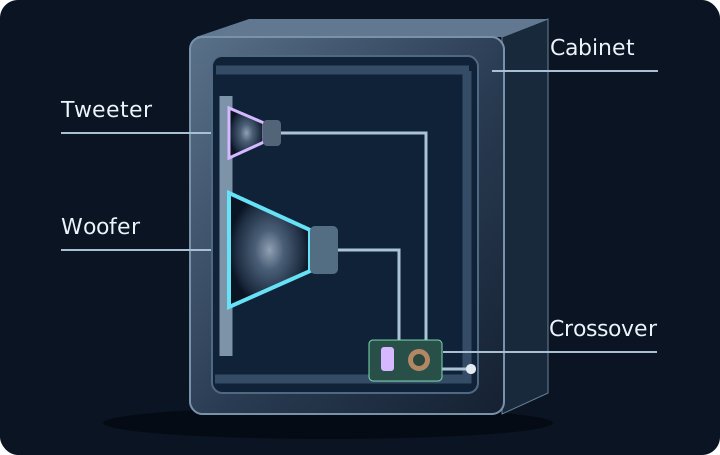
Cone materials such as paper, treated paper, polypropylene, aluminum and composites have different combinations of mass, stiffness and damping. A designer can exploit those qualities, but the material alone doesn't guarantee the final frequency response or distortion. Likewise, the surround and spider help control movement and can affect durability and resonance.
Foam, rubber and treated-cloth surrounds each offer particular compliance, damping and aging properties. Foam isn't universally inferior, and an exotic cone isn't necessarily better. Cabinet construction, driver geometry, crossover behavior and response away from the center seat are integral to the result.
MORE DRIVERS DOES NOT AUTOMATICALLY MEAN MORE FIDELITY
Are three-way speakers better than two-way speakers?
Not necessarily. The number of ways refers to the main frequency bands assigned to different driver sections, not the number of circles on the speaker's face. A two-way can have two woofers and a tweeter; a coaxial two-way can look like one physical assembly. Another driver can solve a genuine problem, or introduce a new one.
Count the frequency roles, then count the drivers
2-way · 2 drivers shown

- Treble
- Bass + midrange
2.5-way · 3 drivers shown

- Treble
- Bass + midrange
- Bass support
3-way · 3 drivers shown

- Treble
- Midrange
- Bass
4-way · 4 drivers shown

- Treble
- Upper midrange
- Lower midrange
- Bass
ONE-WAY / WIDE-RANGE
One diaphragm handling most of the spectrum
May avoid a conventional handoff between woofer and tweeter. But asking one diaphragm to reproduce deep bass and upper treble can compromise bandwidth, high-level output or dispersion. Some wide-range units use a whizzer cone.
TWO-WAY
A woofer/midwoofer plus a tweeter
One main handoff between low/midrange and treble. Relatively simple to integrate, but the woofer typically handles bass excursion and much of the midrange, demanding a compromise between low-end output and upper-range dispersion.
2.5-WAY
Three drivers, but not three full bands
Usually a tweeter and two similar woofers. Both support low bass; one tapers off sooner, leaving the other to cover more of the midrange. Useful for extra low-frequency output or baffle-step management without a fully separate midrange section.
THREE-WAY
Dedicated bass, middle and treble roles
A midrange specialist can relieve the woofer and tweeter of difficult bandwidth demands, especially in high-output systems. But another crossover and spaced acoustic source add cost and phase/dispersion integration challenges.
FOUR-WAY OR MORE
Additional specialized frequency bands
Can divide deep bass, low midrange, upper midrange and treble for ambitious designs. Extra transitions, space and cabinet complexity need justification. Four ways do not automatically reproduce music more faithfully than three.
MANY DRIVERS ≠ MANY WAYS
Several diaphragms can play the same range
Two, four or more woofers can share bass duty while the system remains two- or three-way. Their combined cone area may improve displacement and reduce each driver's excursion, but overlapping sources can also affect off-axis radiation.
When do extra drivers actually help?
They can move more air, share excursion and heat, let a midrange driver avoid large bass movement, or help a designer control dispersion. But crossover filters create overlap regions, not brick-wall handoffs. Overlapping drivers can reinforce or cancel at different angles, depending on their spacing, phase, natural responses and filtering. More drivers can therefore mean more output or harder acoustic integration. Compare measured off-axis response, distortion, maximum clean output and real bass performance rather than driver count.
What about those huge 1970s cabinets covered in tweeters and horns?
Vintage hobbyists sometimes use the informal and often derogatory nickname “Kabuki speakers” for elaborate multi-driver cabinets, particularly some Japanese models from the 1960s and 1970s. It's not a formal engineering category or a reliable verdict on a manufacturer, country of origin or individual loudspeaker. A super-tweeter, horn, extra midrange or level control is only worthwhile if it contributes to the intended acoustic result.
Driver-count marketing was questioned even in a 1977 Stereo Review discussion. But dismissing every elaborate vintage speaker would make the opposite mistake. Some listeners enjoy them, and some elaborate designs are well engineered. What matters is how the complete speaker measures and behaves, not whether its grille conceals two drivers or ten.
THE EASY ASSUMPTION
“Three tweeters and two midranges must provide more detail than one of each.”
THE BETTER QUESTION
Do the added drivers increase useful output or improve coverage? Or do they introduce response variations, lobing or unnecessarily complex crossover behavior? Test the entire loudspeaker.
Let's go deeper: why crossovers and driver spacing matter Optional
One conventional two-way handoff means one main crossover region; a three-way generally has two. Electrical filters combine with drivers' natural acoustic roll-offs, acoustic centers and the frequency-dependent phase relationship at the listening position. Their radiation adds or cancels differently off axis, making crossover alignment and driver spacing important. A 2.5-way intentionally has its extra woofer roll off before the main midrange-to-tweeter handoff. Active DSP, coaxial drivers and engineered arrays can solve some integration challenges but do not remove every trade-off. The number of drivers and the number of crossover bands must be evaluated separately.
Sealed vs. bass reflex: what the cabinet does for bass
A woofer moves air from both sides of its cone. A sealed cabinet traps the rear radiation, and the air inside acts like a spring. A bass-reflex (ported) cabinet uses the air in a tuned vent and the air inside the box as a resonator. Near the tuning frequency, the port supplies much of the bass output and the woofer cone moves less.
- Sealed: The bass typically rolls off more gradually. Achieving the same deep-bass level can take more cone travel and amplifier power, especially if equalization is used.
- Bass reflex: The port can give you more output near tuning or extend useful bass lower. Well below tuning, output generally falls faster and cone excursion can rise as the driver loses the acoustic loading it had near tuning. At high output, an undersized port can make audible wind noise.
Either enclosure can be used in a two-way or multiway design. Compare bass extension at the same dB tolerance and clean output at your listening level. For a rear port, leave the clearance specified by the manufacturer. Both sealed and ported boxes interact with nearby walls.
What a subwoofer adds, and why placement matters
A subwoofer handles the lowest frequencies, adding extension or clean bass output that the main speakers may lack. A low-pass filter limits what the sub plays. If your system also high-passes the mains, their woofers do less deep-bass work, which can free up headroom. With a low-pass on the sub alone, the mains still receive their usual bass signal.
Moving the sub changes which room modes it excites. These standing waves can make a bass note boom in one seat and nearly disappear in another. A wall or corner can increase output while making some notes stronger than others. Try a spot near the front wall, slightly off-center, and compare it with another location using the same bass sweep or track at your usual seats. Once you pick a spot, adjust crossover, level and phase or delay so the sub and mains add smoothly where they overlap.
THE LISTENING CONNECTION
What could you actually hear?
The speaker's tonal balance, dispersion and resonances can influence guitar presence, vocal focus and cymbal character. Those outcomes must be evaluated in the finished speaker, not predicted from a tweeter material alone.
Driver breakup modes, crossover summation and room reflections can produce audible peaks or dips. Likewise, a thoughtfully designed two-way may outperform a poorly integrated three- or four-way, while a carefully designed multiway can achieve greater clean output and consistent coverage. A well-designed speaker using ordinary materials can outperform a premium-material model in real listening.
WHAT AUDIOPHILES SAY
“Beryllium is the holy grail,” “soft domes are warm,” and “paper cones are slow” are claims that often confuse material properties with the behavior of a complete loudspeaker.
WHAT THE EVIDENCE TELLS US
Mass, stiffness and damping affect achievable driver behavior, but the final radiated sound depends on geometry, motors, resonances, crossover and enclosure. There is no universal performance ranking by diaphragm material.
CHOOSING REAL EQUIPMENT
What should you look for?
- Look for actual frequency response, off-axis behavior and distortion rather than ranking speakers by driver material.
- Check whether the cabinet and crossover integrate the drivers smoothly around the handoff.
- Consider replaceable parts and aging of surrounds and other components in older used speakers.
- Count frequency bands separately from drivers, and ask what the extra drivers accomplish. Seek actual off-axis measurements and distortion/output tests.
Other variables in the chain
Enclosure design, driver diameter, resonance damping, crossover slope, waveguide shape, baffle and room acoustics.
Engineering deep dive Optional
The crossover creates electrical filter responses that interact with driver acoustic roll-off, impedance, phase, and acoustic-center offsets. A two-way system may have more than two physical drivers, and the driver sizes alone do not specify the crossover point. Material breakup modes can be suppressed using geometry, damping and filtering.
Sources and further reading
Diagrams are original illustrations, not measured consumer products.
- Klippel: loudspeaker measurements and nonlinearities ↗
- Audioholics: Speaker crossover design ↗
- KEF Reference technical paper: trade-offs behind its three-way design ↗
- Dynaudio: why use a 2.5-way design? ↗
- AudioControl: crossover and multiway integration ↗
- Stereo Review (August 1977, p. 26): multi-driver design and marketing ↗
- Audiokarma: vintage community discussion of the informal “Kabuki” nickname ↗
- SVS · One subwoofer’s design trade-offs across sealed and ported tuning modes ↗
- Genelec · Subwoofer placement and bass management ↗