
LESSON 10 · HEADPHONES · DESIGN & FIT
How do headphone cups and fit change what you hear?
Look at the back of the cup to understand leakage. Look at the pad or tip to understand where the headphone sits and how it seals.
A power-based sensitivity rating. See the exact reference point ↓
DECODE THE EXAMPLE
32 Ω · 102 dB SPL at 1 mW
Illustrative calculation for a linear, fictional headphone.
One reference point under a test condition
32 Ω is the nominal electrical load. 102 dB SPL at 1 mW means the headphone produces a sound-pressure level of 102 dB with one milliwatt of electrical input in the example test. A tenfold power change moves the idealized line by 10 dB.
Treat 102 dB SPL as the test reference only. Use the design description for cup and fit information. Use the headphone sensitivity lesson to compare ratings in dB per milliwatt and per volt.
What is behind the driver?
Compare the grille, vents and solid back. The examples all use over-ear pads so you can focus on the enclosure.
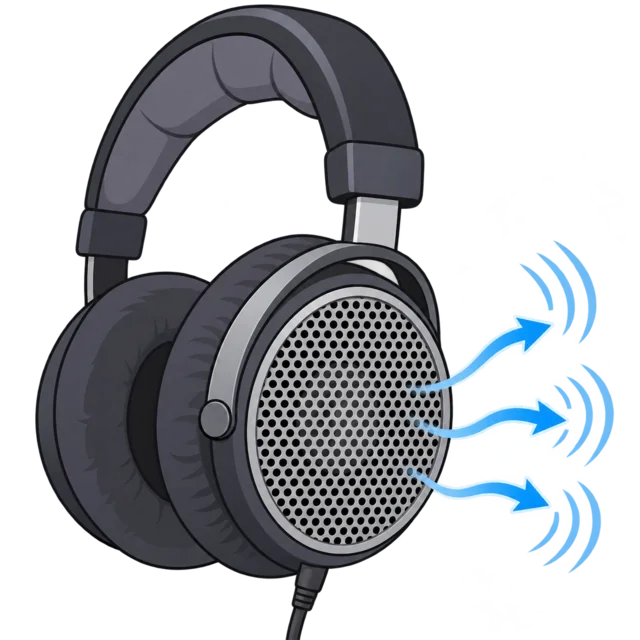
Open-back
An open-back headphone has a grille behind the speaker-like driver rather than a sealed cup. That usually lets room noise in and some of your music out. It suits a quiet room better than a noisy bus.
Some listeners enjoy the sense of space in a quiet room. Tuning, the recording and your ear shape also influence that impression.
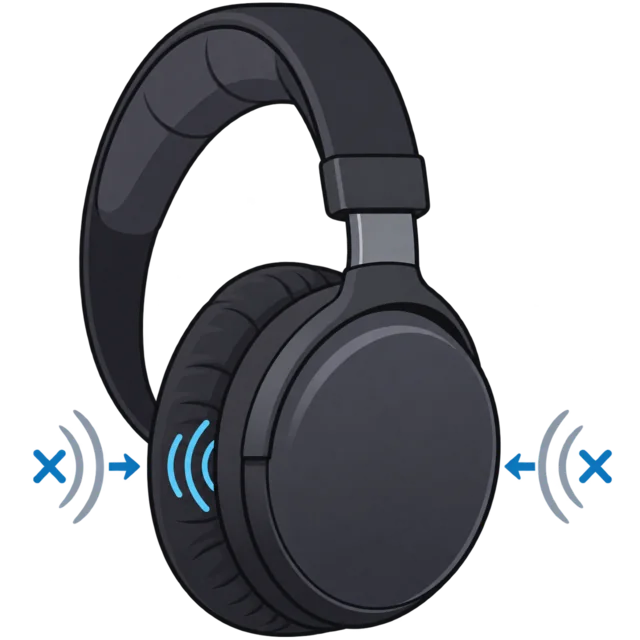
Closed-back
A solid rear shell forms a chamber behind the driver. It typically reduces leakage and blocks more outside noise. A closed design can still use small tuning vents.
Pad fit and internal damping affect the response. Glasses, hair or worn pads can leave a gap that reduces bass on some models.
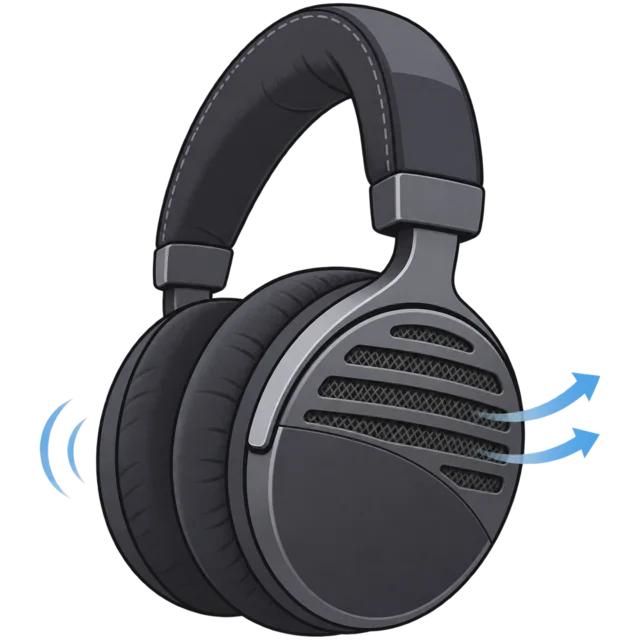
Semi-open
This example uses a partly vented rear cup. Manufacturers use “semi-open” for different amounts of acoustic venting, so leakage and isolation vary by model.
Check a specific model’s isolation and leakage if you share a room or record next to a live microphone.
Illustrations show representative constructions. The arrows indicate a sound path, with leakage varying by model.
Where does the pad or tip sit?
Over-ear and on-ear headphones can each have open or closed backs. In the two pad cutaways, blue shows the cushion and the gold dots mark where it touches.

The cushion rests on the head around the ear. A roomy cup can be comfortable for long listening sessions. Check cup depth and fit with glasses.

The cushion rests directly on the outer ear. A compact model is easy to carry in a day bag. Check the clamp and cushion softness.
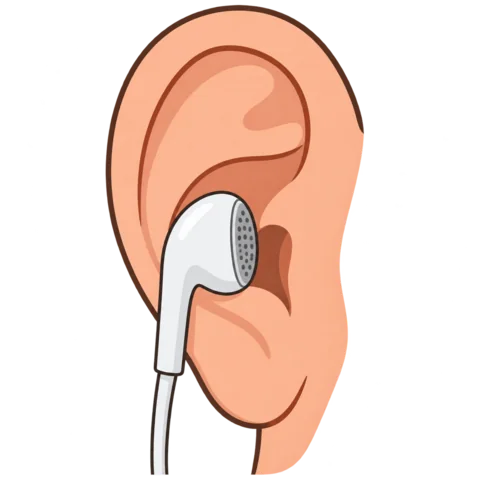
The shell rests in the bowl of the outer ear and leaves the canal open. Choose it for a shallow fit that lets more of the room in.
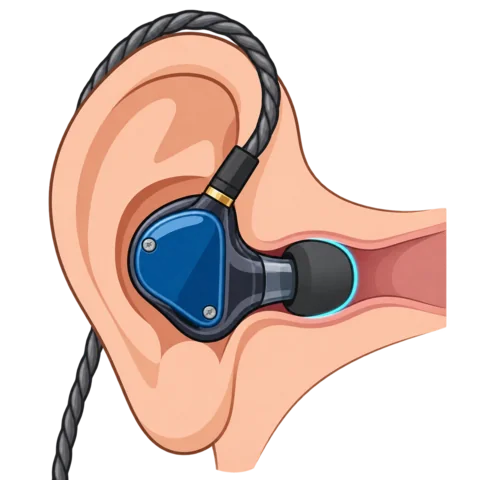
A tip seals at or just inside the canal opening. A good seal helps preserve bass and reduce outside noise on a commute or when monitoring onstage.
What moves the air?
Every headphone needs something to move air. A common dynamic driver moves a thin surface using a coil and magnet, much like a small speaker. A planar magnetic driver spreads the electrical conductors across a thin surface. Some in-ear monitors (IEMs) use tiny balanced-armature mechanisms. Electrostatic models use an electrically charged surface and generally need a special amplifier. The design name tells you how it works, not automatically how good it sounds.
Some IEMs combine driver types and use crossovers to divide the frequency range. Driver choice influences how the device can be built and tuned. Listen to and compare measurements of the finished headphone to evaluate the result.
What might change when you put them on?
Room noise and sound leakage are often the clearest differences between open and closed cups. Tuning and how the headphone sits on your ears also shape the sense of space.
If an IEM suddenly loses low bass, try a comfortable tip that seals. If an over-ear model sounds thinner with glasses on, reseat the pad and compare at the same volume. The response and fit lesson shows that kind of bass change on a graph.
COMMON CLAIM
“More IEM drivers means more detail.”
WHAT TO CHECK
Several drivers give a designer more ways to divide the work. Crossovers, acoustic paths, tuning and fit determine what reaches the ear.
What should you look for?
- Pick the enclosure based on how much room noise and leakage you can live with.
- Choose a pad or tip that fits comfortably for a full listening session. Include glasses if you wear them.
- Use sensitivity and impedance together to check the drive requirement. For sensitive IEMs, also check the source for audible hiss.
Engineering deep dive Optional
For an ideal resistive load, Ohm’s law and the power equation give P = V²/R. If the driver stays linear, a power ratio P/P₀ changes sound pressure level by 10 log₁₀(P/P₀) dB. The sample 32 Ω headphone uses about 0.179 V RMS to draw 1 mW. An actual headphone’s impedance can vary with frequency.
Sources and further reading
- beyerdynamic · Open, closed and semi-open enclosures ↗
- ITU-T P.57 · Circumaural and supra-aural fit (§§3.2.4 and 3.2.14) ↗
- RTINGS · Photos of over-ear and on-ear headphones ↗
- Shure · Tip fit, seal and bass response ↗
- Sound On Sound · Designing and measuring reference headphones ↗
- Texas Instruments · Headphone amplifier and sensitivity considerations ↗