
Soundstage width
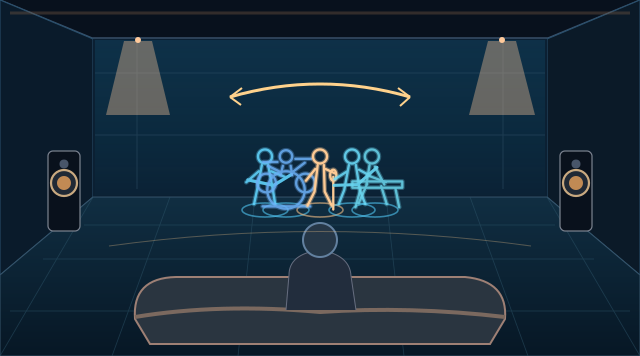
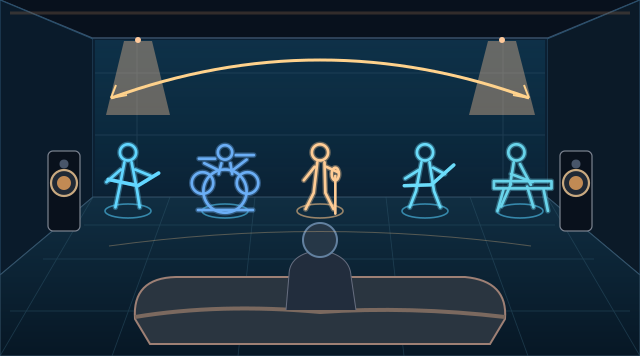
Width is the apparent left-to-right extent of the sound. A wider stage is not automatically more accurate; it depends on the recording and playback geometry.
AUDIOPHILE DECODER · FIRST EDITION
Reviewers say music is holographic, punchy, muddy, or effortless. These words describe impressions, not measurements. Here’s what people usually mean, the sounds to listen for, and how recordings and equipment could be involved.
The description can be genuine even when the proposed cause is wrong. “The music sounds congested” is an observation. “The amplifier is underpowered” is a hypothesis. Proving the second requires more evidence.
FIND THE WORD
Definitions stay simple. Open “What might create this impression?” to see where the recording, speakers, room, headphones and amplifier fit.
32 listening terms across four groups.
No matching terms. Try a shorter word or another listening description.
VISUAL LISTENING GLOSSARY · THE GHOST BAND
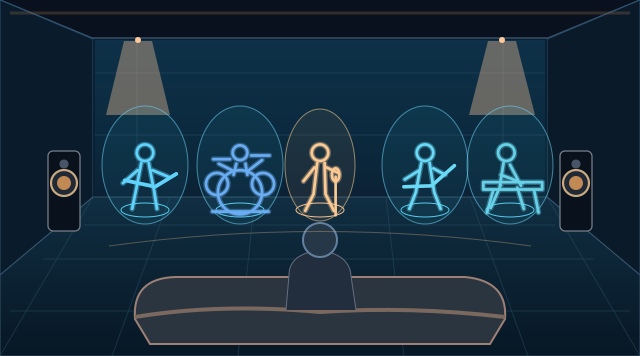
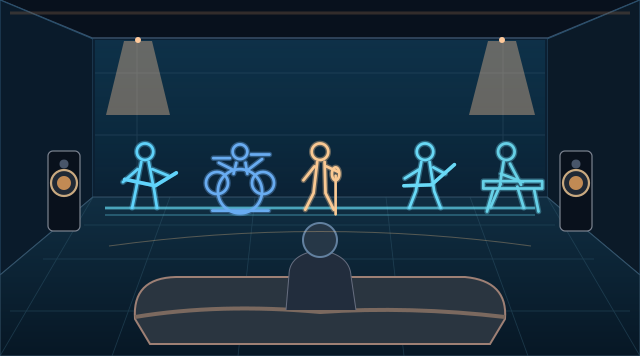
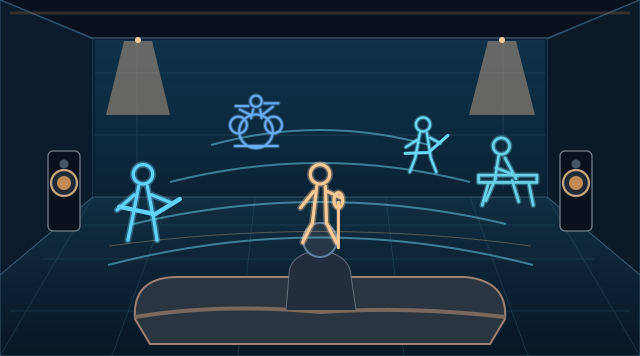
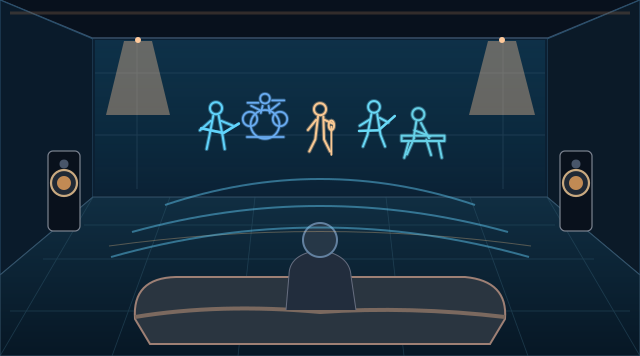
The same listener, couch and stereo speakers remain in place. Only the perceived musicians change. Compare the scenes to understand five common listening descriptions.
Concept, not measurement: these are illustrated impressions, not speaker tests, real sound-field measurements or guarantees about any amplifier.
Width is the apparent left-to-right extent of the sound. A wider stage is not automatically more accurate; it depends on the recording and playback geometry.
Imaging describes how distinctly and consistently you can locate a source. Stage width alone does not establish accurate imaging.
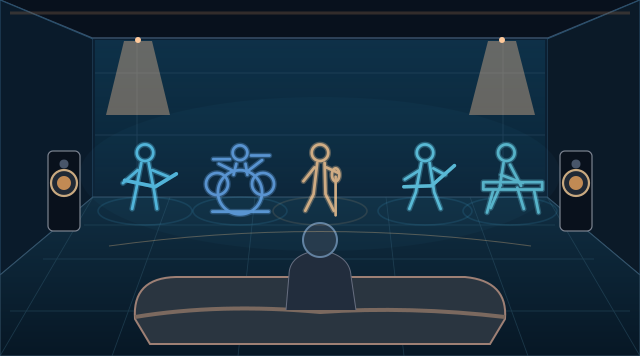
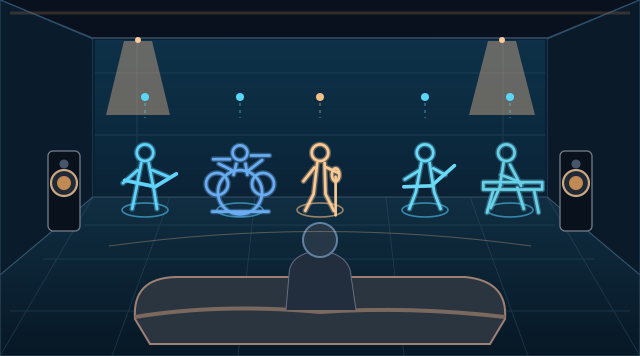
This comparison illustrates perceived separation, not a literal physical gap. Masking, recording density and playback distortion may affect the result.

Depth is an impression built from recording cues and room interactions. More depth is not proof of better fidelity if the recording is intentionally flat.
Forward and laid-back describe perceived presentation, not a measurement of physical performer distance. Level, mix and tonal balance can influence the impression.

01 / LISTENING LANGUAGE
Warm, bright, harsh and other words for the balance of notes and their edges.
A rounded sound with plenty of body and less emphasis on sharp upper notes.
Picture this: A singer sounds rich rather than thin or piercing.
The singer, microphone, mix and mastering can all set this balance.
A little extra upper bass or lower midrange, or gentler treble, can sound warm; room placement also matters.
A normally operating, flat-response amplifier should not add much warmth. Tone controls, intentional coloration or load interaction can.
Related lesson: Speaker frequency response
Treble and upper-midrange sounds stand out strongly.
Picture this: Cymbals, pick attacks and the edges of consonants come forward.
A bright recording may already place these sounds up front.
Speaker or headphone tuning, listening angle and reflective rooms can raise apparent treble.
An amplifier is rarely the main cause unless EQ, clipping or unusual load interaction is involved.
Related lesson: Speaker frequency response
High notes feel subdued compared with the rest of the music.
Picture this: Cymbal shimmer and vocal consonants sound less prominent.
Some recordings intentionally sound restrained on top.
Off-axis listening, headphone tuning, furnishings or a downward-tilted response can contribute.
A flat, unclipped amplifier usually preserves the source balance; filters or tone controls can change it.
Related lesson: Speaker frequency response
Voices or instruments seem to move closer to you.
Picture this: A guitar sounds like it is at the front of the room.
See illustration: Forward versus laid-back ↗
The mix can make a part loud, dry or close-miked.
Upper-midrange balance and early reflections can change how near a sound feels.
Channel balance and level matter; amplifier class alone doesn't establish a forward sound.
Related lesson: Speaker frequency response
Music feels less upfront or aggressive, sometimes more distant.
Picture this: A singer sits behind the instruments rather than in front.
See illustration: Forward versus laid-back ↗
Recording ambience and relative instrument levels create much of the impression.
A softer presence region or more room contribution can shift perceived distance.
If adequately powered and neutral, the amplifier normally has little direct say in depth.
Related lesson: Speaker frequency response
Soft high-frequency details and the space around a sound are easy to hear.
Picture this: The decay of a cymbal or breath around a vocal feels open.
The recording must contain those high notes and ambience cues.
Treble response, dispersion, room absorption and headphone fit can preserve or obscure them.
Noise or distortion can mask quiet tails if present; more advertised bandwidth alone doesn't create air.
Related lesson: Speaker frequency response
Voices and instruments have satisfying weight without sounding hollow.
Picture this: An acoustic guitar has wooden resonance as well as bright strings.
Instrument choice, microphone distance and the mix establish much of the body.
Upper-bass and lower-midrange level and room effects can reinforce or exaggerate it.
Clean output helps keep it intact at level; a high wattage figure does not guarantee fullness.
Related lesson: Speaker frequency response
Sound lacks the body you expect beneath its upper notes.
Picture this: A snare has snap but little shell resonance.
The original arrangement or microphone position may be lean.
Low-midrange cancellation, tonal balance, placement or headphone seal can reduce body.
An amplifier rarely makes a system thin unless the signal path or load interaction changes its response.
Related lesson: Speaker frequency response
A sharp, tiring edge makes louder passages unpleasant.
Picture this: A distorted guitar or vocal peak sounds grating rather than powerful.
A close-miked or aggressively mastered recording can already have an edge.
Upper-midrange peaks, resonances and high-level speaker distortion can aggravate it.
Clipping or other nonlinear behavior can add roughness at higher output. Don't diagnose clipping from the word alone.
Related lesson: Amplifier distortion and THD+N
The 's', 'sh' and 't' sounds in speech or singing jump out too much.
Picture this: A vocalist's esses hiss more loudly than surrounding vowels.
The singer, microphone, de-essing and master may determine the sibilance.
Treble emphasis or a resonance can spotlight an already sibilant vocal.
An amplifier that stays clean and flat usually doesn't manufacture sibilance; overload can make edges worse.
Related lesson: Speaker frequency response
Tones connect without obvious sharp peaks or rough edges.
Picture this: A sustained violin or voice sounds easy to follow.
Performance, mix and recording texture can be naturally smooth.
Even response without strong resonances can help; overly subdued treble may also be called smooth.
Low distortion is useful, but smooth is not a numerical rating.
Related lesson: Amplifier distortion and THD+N
A fine, sandy or rough texture seems to ride on top of sounds.
Picture this: A held vocal or fading cymbal seems slightly raspy.
The texture could be intentional, recorded noise or a lossy-codec artifact.
Resonances or an uneven frequency balance can make an existing roughness more noticeable.
Distortion or noise is one possibility, not a confirmed explanation without checking the signal.
Related lesson: Amplifier distortion and THD+N
02 / LISTENING LANGUAGE
What makes a kick hit hard, a bass line linger, or a chorus feel effortless.
Low notes start and stop distinctly, with separate pitches instead of one continuous rumble.
Picture this: A bass line can be followed note by note even when the drummer plays.
Bass playing, production and compression shape timing and envelope.
Speaker tuning, subwoofer integration and room bass decay are major contributors.
Adequate current and clean voltage matter; a large damping-factor number alone cannot promise tight bass.
Related lesson: Bass extension
One or more bass notes swell or linger longer than they should.
Picture this: Every kick seems to ring with the same low note.
A mix may boost a narrow bass range.
The room can make some bass notes boom or linger while others fade. Where you place the speakers, subwoofer and seat changes that balance.
If the amplifier is driving the speakers cleanly, it usually isn't what makes one bass note linger. Its electrical interaction with the speaker can matter, but the room and speaker response are often more useful places to check.
Related lesson: Bass extension
Low and middle sounds blur, making parts hard to tell apart.
Picture this: A bass guitar seems to swallow the body of acoustic-guitar chords.
Crowded arrangements and bass-heavy mixes can hide detail.
Too much bass or lower midrange, strong reflections and room resonances can mask nearby sounds.
Clipping or rising distortion can worsen it under stress, but 'muddy' does not prove an underpowered amp.
Related lesson: Speaker frequency response
The first instant of a hit feels sharp and clearly defined.
Picture this: A snare snaps out of a groove without the whole mix turning up.
The way the musician strikes the note, how its first instant is processed, and the final mastering all affect how sharply it begins.
A speaker needs enough clean output for a quick hit, and its placement and upper-bass balance affect whether the hit feels punchy.
An amplifier needs enough clean reserve for sudden hits (headroom). But adding watts to a system that already plays those hits cleanly will not create punch that isn't in the recording.
Related lesson: Amplifier power and headroom
A forceful hit combines attack with convincing bass weight.
Picture this: A kick drum hits your chest instead of merely clicking.
The track must contain enough low-frequency energy and contrast.
Bass extension, clean output, room acoustics and listening level strongly affect impact.
Power reserve matters if peaks approach the system's limits; the speaker may run out of clean output first.
Related lesson: Amplifier power and headroom
Quiet and loud moments feel different and hits rise above what surrounds them.
Picture this: A gentle passage turns into a drum-driven section with real contrast.
Arrangement and mastering determine whether contrasts survive the release.
Speaker compression, room noise and achievable clean level can reduce the impact.
An amplifier with enough clean power can play loud peaks without flattening them. It cannot bring back loud-and-quiet contrasts already removed during mastering.
Related lesson: Amplifier power and headroom
Loud and soft parts feel closer in level, or a system stops getting proportionally louder.
Picture this: A chorus arrives but barely feels bigger than the verse.
Dynamic-range compression in mastering can be deliberate.
Speaker thermal or mechanical compression can limit output at higher level.
Near a power or protection limit, an amp may also flatten peaks. The word has different meanings in production and playback.
Related lesson: Amplifier power and headroom
Dense, loud passages retain ease and clarity rather than sounding strained.
Picture this: A loud drum fill stays distinct as guitars and bass join in.
A cleanly recorded and mixed crescendo gives the system something to reproduce.
Speaker sensitivity, clean maximum output, compression and room behavior all matter.
Look at useful headroom and distortion versus output and load, not wattage in isolation.
Related lesson: Amplifier power and headroom
03 / LISTENING LANGUAGE
The language of soundstage, instrument placement and busy mixes.
The apparent width, depth and sometimes height of the sonic scene.
Picture this: The piano seems left of centre while the backing vocals stretch wider.
See illustration: Narrow versus wide soundstage ↗
Stereo panning, timing and recorded ambience provide spatial cues.
Speaker spacing, listening position, dispersion and reflections affect how cues arrive.
An amplifier should preserve left-right level and signal integrity; it does not invent an orchestra-sized room.
Related lesson: Speaker frequency response
How precisely a sound seems located within that scene.
Picture this: A centred vocalist remains centred while a guitar sits clearly to the right.
See illustration: Diffuse versus precise imaging ↗
The mix determines where most recorded sources belong.
Symmetric placement, matched output and first reflections affect image stability.
Good channel balance and sufficiently low crosstalk help preserve the signal; power rating is not an imaging score.
Related lesson: Speaker frequency response
A vivid sense that sounds occupy distinct three-dimensional places.
Picture this: A voice seems suspended between the speakers with space behind it.
See illustration: Flat versus layered depth ↗
Mic technique, panning, reverb and stereo phase cues can create depth.
Stable imaging, appropriate directivity and room reflections can enhance the illusion.
A properly operating stereo amplifier can preserve the left-right and depth clues in the recording. A more expensive DAC or a particular amplifier class doesn't automatically create a bigger three-dimensional illusion.
Related lesson: Speaker frequency response
You can follow individual instruments even during a busy passage.
Picture this: The bass line stays audible beneath layered guitars and drums.
See illustration: Crowded versus clear separation ↗
Arrangement, EQ, panning and masking within the mix are central.
Balanced response, controlled room boom and low speaker distortion at level can help.
If distortion rises near high output, parts may blur. Clean power matters; extra power below the limit may change nothing.
Related lesson: Amplifier distortion and THD+N
Busy music becomes a crowded mass of sound.
Picture this: Tom resonance disappears as the guitars and cymbals get loud.
See illustration: Crowded versus clear separation ↗
The music itself may have densely overlapping parts.
Room resonances, masking and speaker compression or distortion can make the crowding worse.
A rising distortion curve, clipping or current limits may contribute as volume rises. This is a hypothesis until measured.
Related lesson: Amplifier power and headroom
Quiet cues are easy to notice within the whole song.
Picture this: You can hear a pick scrape and the last decay of a cymbal.
Recording quality and the mix decide whether the cues exist.
Response smoothness, noise, room masking and speaker distortion affect audibility.
A low noise floor and clean operation help preserve cues; extra treble can imitate 'detail' without adding information.
Related lesson: Amplifier distortion and THD+N
Part of the recording seems covered or hard to make out.
Picture this: The singer's diction and instrumental overtones feel hidden.
A deliberately soft mix may be the intended sound.
Treble balance, excess low mids, off-axis response and headphone fit can obscure cues.
A neutral amplifier rarely creates a veil; filters, noise or high-level strain can contribute in specific cases.
Related lesson: Speaker frequency response
Hiss, hum and other noise are hard to hear when the music fades.
Picture this: A quiet intro emerges from near silence.
The recording may already contain microphone, tape or room noise.
Room noise and very sensitive headphones or speakers can reveal low-level hiss.
Output noise, ground hum and gain structure matter; signal-to-noise ratio must be compared at stated conditions.
Related lesson: Amplifier distortion and THD+N
04 / LISTENING LANGUAGE
Useful as expressions of preference, less useful as diagnoses.
A broad statement that playback feels engaging and emotionally convincing.
Picture this: You forget the gear and follow the melody and groove.
Performance and production can dominate this reaction.
Tonal balance and room presentation can affect enjoyment.
It is a preference description, not proof of superior measurements or a property of one amplifier class.
Related lesson: Amplifier classes
A sound is perceived as highly revealing, or perhaps emotionally detached.
Picture this: Every edit is obvious, but the listener finds it less involving.
A sparse, revealing mix may invite this description.
Bright balance and low coloration may be described this way by some listeners.
Low distortion does not force a clinical character. Ask exactly which sound prompted the adjective.
Related lesson: Amplifier classes
A shorthand for a quality someone associates with tape or records.
Picture this: A soft high end, gentle saturation or rounded transient comes to mind.
The original analogue recording, master or an emulation may contain those traits.
Speaker response can evoke a similar subjective balance.
Tape, vinyl, tubes and digital playback are not one sound. Noise, distortion and EQ differ case by case.
Related lesson: Amplifier classes
Playback seems to add little character of its own.
Picture this: Changing from one clean component to another leaves the music unchanged.
Source fidelity sets what is available to reproduce.
Room and speaker response often cause larger departures from neutrality.
Evaluate frequency response, noise and distortion at relevant levels; transparency is not established by marketing language.
Related lesson: Amplifier distortion and THD+N
THE GEAR CONNECTION
No single speaker material or amplifier class guarantees a sound. Start with the quality you want and the conditions where you listen.
Speaker & room: Look for reasonably even response, controlled bass in your room and low distortion at your usual level. Too much bass can cover guitars and vocal texture.
Amplifier: Useful clean output at your actual speaker load. Check distortion versus output, not just its biggest watt number.
Understand distortion →Speaker & room: Matched speakers, sensible spacing, similar distances to the seat and manageable early reflections. Off-axis response can matter across a wide couch.
Amplifier: Good left-right balance and low crosstalk preserve spatial cues. The mix supplies the actual locations.
Understand response →Speaker & room: Look beyond bass extension. Room modes, subwoofer placement and how long bass lingers can dominate the result.
Amplifier: Match the electrical load and clean output. Damping factor alone is not a bass-quality score.
Understand bass extension →Speaker & room: Sensitivity, clean maximum output and speaker compression matter. A small speaker can run out of clean bass before the amp runs out of watts.
Amplifier: Compare headroom with distortion and real speaker impedance at the volume you want.
Understand headroom →Speaker & room: Room noise and speaker or headphone sensitivity set what you can hear between notes.
Amplifier & source: Output hiss, grounding, gain and source noise can matter; compare noise specifications under similar conditions.
Understand measurements →Speaker & room: Response, listening angle, headphone fit and room position often affect warmth, brightness and body.
Amplifier: Tone controls or measurable frequency-response/load interactions can change balance. Class A, AB and D are not sound presets.
Understand amplifier classes →WORDS BEHIND THE WORDS
You’ll meet these terms when exploring why a listening impression happens. They explain a possibility; they don't automatically diagnose a system.
This first edition documents the language and plausible mechanisms. Sound samples, level-matched comparisons, measurement walkthroughs and verdicts belong to later editions. No entry claims that a particular product or listening report has been verified.